
FOREWARNED IS FOREARMED
What would you if this came to pass?

The NYTimes made a compilation of Trump threats and challenges to anyone not MAGA:
Trump Administration Live Updates: Trump’s Signature to Be Added to U.S. Dollars, a First for a Sitting President
Mail-in Voting: President Trump defended his use of mail-in voting in this week’s special election in Palm Beach County, Fla., despite having repeatedly claimed that such ballots are used for “cheating.” Read more ›

March 26, 2026, 6:04 p.m. ET2 hours ago
Economic policy reporter
Trump’s signature will appear alongside that of the Treasury secretary.
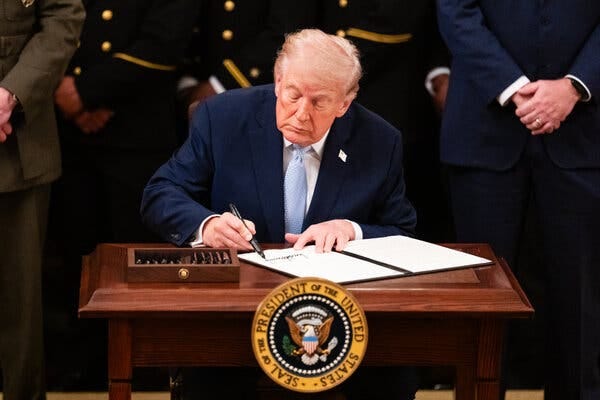
The addition of President Trump’s signature to dollars is the latest example of his emblazoning national institutions with his personal brand.Credit...Eric Lee for The New York Times
President Trump’s signature will appear on U.S. dollars later this year, the Treasury Department said on Thursday. The decision to have Mr. Trump’s John Hancock on America’s paper currency represented an unprecedented change, one that the department said was being made in honor of the United States’ 250th anniversary.
As a result, Mr. Trump is set to become the first sitting U.S. president to have his signature on the greenback. His name will appear alongside that of Treasury Secretary Scott Bessent. As a result, the U.S. treasurer, whose name has been on the currency for more than a century, will not appear on the currency.
“There is no more powerful way to recognize the historic achievements of our great country and President Donald J. Trump than U.S. dollar bills bearing his name, and it is only appropriate that this historic currency be issued at the semiquincentennial,” Mr. Bessent said in a statement.
The addition of Mr. Trump’s signature to dollars is the latest example of the president emblazoning national institutions with his personal brand as he looks to permanently imprint his legacy in American society.
Since retaking the White House last year, Mr. Trump has pushed for the minting of a one-dollar coin featuring his face along with the creation of a commemorative, 24-karat gold coin bearing his image. Mr. Trump also had his name added to the John F. Kennedy Center for the Performing Arts in Washington and his administration has pushed for Washington’s Dulles Airport to be renamed after him.
In his first term, Mr. Trump had his signature added to millions of economic stimulus checks that were mailed to Americans during the pandemic.
The history of who gets to sign the money dates to 1861, when President Abraham Lincoln signed a bill allowing the Treasury secretary to delegate the treasurer of the United States to sign Treasury notes and bonds. According to the Bureau of Engraving and Printing, 1914 was the first year that the Treasury secretary and the treasurer started signing the currency together.
During the Biden administration, there was a delay in adding Treasury Secretary Janet L. Yellen’s signature to the money because President Joseph R. Biden Jr. was slow to appoint a new treasurer.
It is not clear if Mr. Trump’s signature will appear on all currency notes. The Treasury Department did not respond to a request for comment.
Brandon Beach, Mr. Trump’s treasurer, expressed support for the president’s signature replacing his on the greenback.
“The president’s mark on history as the architect of America’s Golden Age economic revival is undeniable,” Mr. Beach said in a statement. “Printing his signature on the American currency is not only appropriate, but also well deserved.”
Changes to the features of American currency are often fraught with controversy.
During the Obama administration, Treasury Secretary Jacob J. Lew initiated an effort to make Harriet Tubman, the former slave, abolitionist and “conductor” on the Underground Railroad, the face of the $20 note. That stalled during Mr. Trump’s first term, and Mr. Biden did not revive the change.
The move to add Mr. Trump’s signature could stir controversy of its own.
“Why is this in the national interest?” asked Douglas Holtz-Eakin, a Republican economist who served in the administration of former President George W. Bush.
Noting that Mr. Trump has a full agenda and that fewer people are using cash, Mr. Holtz-Eakin added, “This may be the ultimate act of futility.”
Show more
D.H.S. Shutdown


March 26, 2026, 6:10 p.m. ET2 hours ago
Michael Gold and Megan Mineiro
Reporting from the Capitol
Trump says he will sign an order to pay T.S.A. agents.
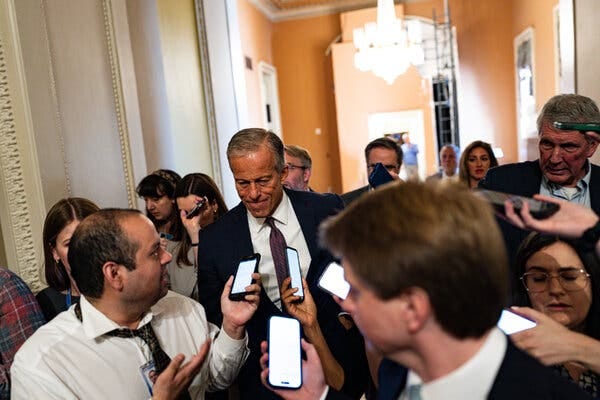
Senator John Thune, Republican of South Dakota and the majority leader, surrounded by reporters outside the Senate chamber on Thursday.Credit...Tierney L. Cross/The New York Times
President Trump said on Thursday that he would sign an emergency order to pay Transportation Security Administration agents, as senators struggled to break their logjam over funding the Department of Homeland Security and end the intensifying crisis at airports.
With long lines at airports ahead of a prime spring travel weekend, and with lawmakers eager to compromise ahead of their two-week recess, Democrats and Republicans spent the day haggling over an elusive deal amid disputes over Mr. Trump’s immigration crackdown. They continued to trade proposals, at times in public in the Senate chamber, to end a weekslong impasse.
But even as the pace of conversations picked up, there was still no sign of a deal by dusk, which Mr. Trump acknowledged in a social media post announcing his plan. “I am going to sign an Order instructing the Secretary of Homeland Security, Markwayne Mullin, to immediately pay our TSA Agents in order to address this Emergency Situation,” he said.
The details of Mr. Trump’s order were not immediately available, including what authority the White House would cite to move the funds. Democrats had been pressing to separately fund the T.S.A. for weeks, an approach that Republicans repeatedly rejected since the partial government shutdown began on Feb. 14.
Senator John Barrasso of Wyoming, the No. 2 Republican, said that Mr. Trump was “going to repurpose funds,” though he did not explain how. But Mr. Barrasso acknowledged that senators, who have traditionally fought to preserve their power of the purse, “would have preferred to get this done here on the floor of the United States Senate.”
Republicans on Thursday morning sent Democrats what Senator John Thune of South Dakota, the majority leader, called “our last and final” offer. It would have funded the department without money for Immigration and Customs Enforcement’s deportation and detention operations.
But Democrats have continued to insist that any measure still include limits on federal immigration agents, and that no funds be moved from other parts of the department for immigration enforcement efforts.
Senator Chris Coons, Democrat of Delaware, hinted at productive talks, saying that the “back-and-forth” was continuing between the two parties.
“I think the good news is that there is very broad agreement that we have to fund T.S.A.,” he said. “The bad news is that there’s not yet agreement on exactly how to fund D.H.S. without Democrats funding ICE, and we’re trying to get clarity on exactly what that looks like.”
The negotiating was happening in closed-door meetings and in public, as bipartisan groups of senators huddled in the Senate chamber to discuss the shape of a potential deal. Still, by Thursday evening, optimism had faded.
Senator Mike Rounds, Republican of South Dakota, looked glum when he was asked whether lawmakers had made progress on negotiations.
“No,” he said, shaking his head before heading to the Senate floor.
The House on Thursday separately voted to pass a bill to fund the Homeland Security Department, the third time in two months that the chamber had done so. Four Democrats joined Republicans in supporting the bill, which passed 218 to 206.
Still, a funding bill remains stalled in the Senate, where 60 votes are required for major legislation to move forward. With the Trump administration eager to alleviate lines at some of the nation’s busiest airports, lawmakers and officials were exploring alternatives that would pay airport security workers in the absence of a larger funding deal.
Senator John Kennedy, Republican of Louisiana, said he would push for a separate bill that would fund just the T.S.A. And before Mr. Trump’s announcement, officials had considered whether they could find a way to pay T.S.A. agents by using funds that Republicans gave the department last year as part of their sweeping tax and domestic policy bill.
Senator Susan Collins, Republican of Maine and the chairwoman of the Appropriations Committee, told reporters on Thursday that the Office of Management and Budget had determined that Mr. Trump had the authority to use funds this way.
Carl Hulse contributed reporting.
Show more
March 26, 2026, 7:52 p.m. ET11 minutes ago
Congressional reporter
Senator John Thune, Republican of South Dakota and majority leader, called Trump’s announcement of an emergency order to pay Transportation Security Administration agents a “short-term solution,” suggesting negotiations over funding the Department of Homeland Security were likely to continue. “Obviously we want to fund everything within” the department, he said.

March 26, 2026, 7:04 p.m. ET59 minutes ago
The D.H.S. funding lapse has led to the longest partial shutdown in history.
What began as a budget stalemate in February has become the longest partial shutdown on record, which has frozen funds for the Department of Homeland Security for more than a month. If the shutdown continues after this weekend, it will be longer than any previous shutdown, partial or full.
March 26, 2026, 7:04 p.m. ET59 minutes ago
Congressional reporter
Trump’s announcement of an emergency order to pay Transportation Security Administration agents came as some Republicans had weighed supporting a Democratic proposal to fund the T.S.A. separately from the rest of the Department of Homeland Security.
Republicans had blocked that effort for weeks, arguing that it did not make sense to carve out one agency from the rest of the department. But Senator John Kennedy, Republican of Louisiana, suggested today that he was ready to push a bill that would do so.
Mail-in Voting

March 26, 2026, 2:28 p.m. ET6 hours ago
White House reporter
Trump defends use of mail-in voting, saying he did so ‘because I’m president.’
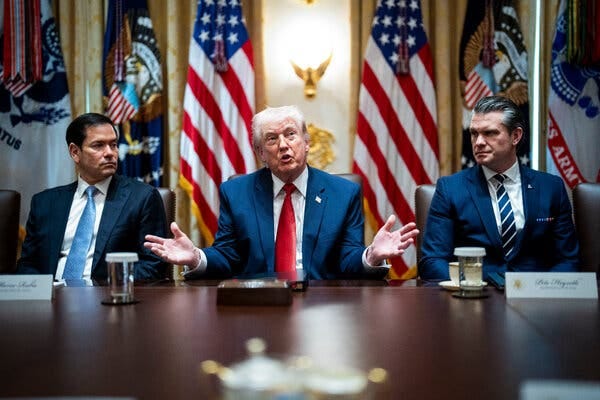
President Trump defended his use of mail-in voting during a cabinet meeting at the White House on Thursday, despite having referred to the practice as “mail-in cheating.”Credit...Doug Mills/The New York Times
President Trump on Thursday defended his use of mail-in voting, saying he cast a ballot by mail recently “because I’m president” and “I had a lot of different things” to do, even as he tries to restrict the practice for most Americans.
Mr. Trump voted by mail in a special election in Florida this week, despite previously saying that mail-in voting amounted to “cheating.” Mr. Trump has called for some exceptions to allow for the practice, such as when voters are ill, disabled, traveling or in the military.
Asked about his vote on Thursday, Mr. Trump said: “You know what, because I’m president of the United States. And because of the fact that I’m president of the United States, I did a mail-in ballot for elections that took place in Florida because I felt I should be here instead of being in the beautiful sunshine.”
Pressed on the fact that he traveled to West Palm Beach, Fla., where he spent time in his residence and played golf — both of which are only 15 minutes driving distance to his polling place — during the early voting period, Mr. Trump said he fit the criteria for the exceptions he has pushed for in what he calls the SAVE America Act.
“I decided that I was going to vote by mail-in ballot because I couldn’t be there, because I had a lot of different things,” he said, without saying which exception applied to him.
“So I was away mostly, in Washington, D.C.,” he said.
The legislation, which Mr. Trump has called “one of the most IMPORTANT & CONSEQUENTIAL pieces of legislation in the history of Congress,” would stiffen voter identification requirements and make mail-in voting significantly more difficult.
“Mail-in voting means mail-in cheating,” Mr. Trump said earlier this week during an appearance in Memphis. “I call it mail-in cheating, and we got to do something about it all.”
Critics of the president’s voting legislation say it would suppress and discourage legal voting, particularly among groups that typically support Democrats, such as naturalized citizens, people of color and lower-income people.
So far, the measure faces an uphill battle in Congress.
Mr. Trump has long fixated on mail-in voting to bolster his baseless claims of widespread fraud in elections. But he also has used mail-in voting himself.
Voter records made public by the Palm Beach County Supervisor of Elections website show that Mr. Trump voted most recently by mail in Palm Beach County, home to his Mar-a-Lago estate, where he has been registered to vote since 2019, and also voted by mail in 2020. That year, he said he voted by mail because he was “allowed to.”
Mr. Trump voted in a special election for a Florida legislative district between the Democrat Emily Gregory and the Republican Jon Maples, whom Mr. Trump endorsed. Ms. Gregory won the election, flipping the seat.
On Wednesday, the day after the special election, Mr. Trump continued to rail against mail-in voting, which he admitted he benefited from in previous elections, particularly in Florida.
“I’ve won with mail-in ballots,” Mr. Trump told Republican lawmakers at a fund-raiser for the National Republican Congressional Committee, “but I hate mail-in ballots, because basically, it’s a way of cheating.”
Show more
Inflation

March 26, 2026, 11:49 a.m. ETMarch 26, 2026
Economic policy reporter
President Trump said during the cabinet meeting that he was amenable to trying to suspend the federal gas tax in a bid to bring down high costs at the pump stemming from the war with Iran. He said he “thought about it, I guess,” later adding it was “something we have in our pocket if we think it’s necessary.”
March 26, 2026, 11:41 a.m. ETMarch 26, 2026
Economic policy reporter
Treasury Secretary Scott Bessent said that he was confident that oil shipping traffic through the Strait of Hormuz would start to increase and that the oil market was “well supplied.” Bessent added that the world would have lower energy prices and less inflation after the war concludes because there would be “absolute security.”
Cabinet Meeting
March 26, 2026, 12:01 p.m. ET8 hours ago
White House reporter
During his cabinet meeting today, President Trump defended his use of mail-in voting in this week’s special election in Palm Beach County, Fla., even as he continues to allege that mail-in ballots are used for “cheating.”
Asked why he chose to use the method, he said, “Because I’m president of the United States. And because of the fact that I’m President of the United States, I did a mail-in ballot for elections that took place in Florida, because I felt I should be here instead of being in the beautiful sunshine.”
When confronted with the fact that he was in West Palm Beach during the early-voting period, during which he played golf at his golf course, he said he had “a lot of different things” to do, and that he was “away mostly, in Washington, D.C.”
March 26, 2026, 11:38 a.m. ETMarch 26, 2026
White House reporter
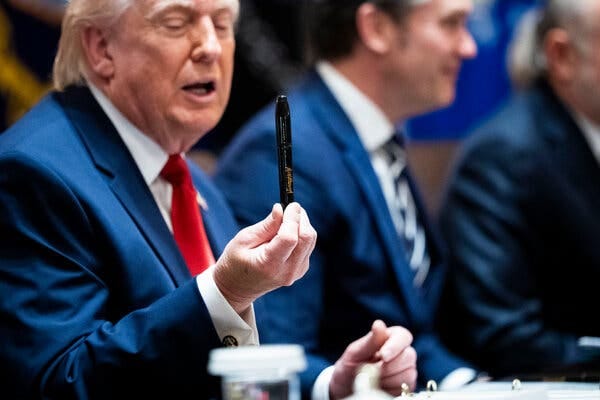
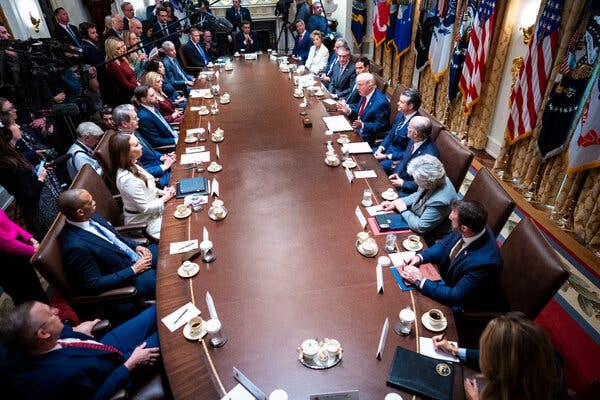
President Trump just spent minutes of the cabinet meeting talking about pens, after spending several minutes complaining about being sued by preservation groups for his renovation projects at the White House and the Kennedy Center.
Credit...Doug Mills/The New York Times
March 26, 2026, 10:54 a.m. ETMarch 26, 2026
White House reporter
After welcoming the new Homeland Security Department Secretary Markwayne Mullin to his first cabinet meeting, President Trump opened by noting that the U.S. is on “day 41 of the disgraceful Democrat shutdown of Markwayne’s department.”
Trump continued to blame Democrats for the lines at airports, which are experiencing long wait times as a result of Transportation Security Administration workers quitting or calling out en masse because they are not being paid.
Earlier this week, Trump derailed a deal between Democrats and Republicans to end the partial government shutdown. Instead, he deployed ICE agents to help staff airports, and said that Democrats needed to end the shutdown immediately “or we’ll have to take some very drastic measures.”
Credit...Doug Mills/The New York Times
March 26, 2026, 10:41 a.m. ETMarch 26, 2026
White House reporter
President Trump is hosting his first cabinet meeting since the U.S. went to war in Iran, and it comes as he is clearly perturbed by his inability to mitigate the fallout of multiple crises, from chaos at U.S. airports to tenuous negotiations in Iran.
This morning, he posted a string of angry social media posts threatening Iran over negotiations, lashing out at NATO allies for not joining the war, pressuring congressional Republicans to “terminate” the filibuster, and blaming Democrats for the ongoing partial government shutdown at the Department of Homeland Security.
More Administration News
March 26, 2026, 5:55 p.m. ET2 hours ago
Economic policy reporter
U.S. dollars will bear the signature of President Trump later this year, an unprecedented change to the nation’s currency that the Treasury Department said was being made in honor of America’s 250th anniversary.
Trump will be the first sitting president to have his signature on the currency. It will appear alongside that of Treasury Secretary Scott Bessent and replace the name of the treasurer, whose name has been on the currency for more than a century.
Bessent said in a statement that there was “no more powerful way to recognize the historic achievements of our great country and President Donald J. Trump than U.S dollar bills bearing his name, and it is only appropriate that this historic currency be issued at the Semiquincentennial.”
March 26, 2026, 3:44 p.m. ET4 hours ago
Congressional reporter
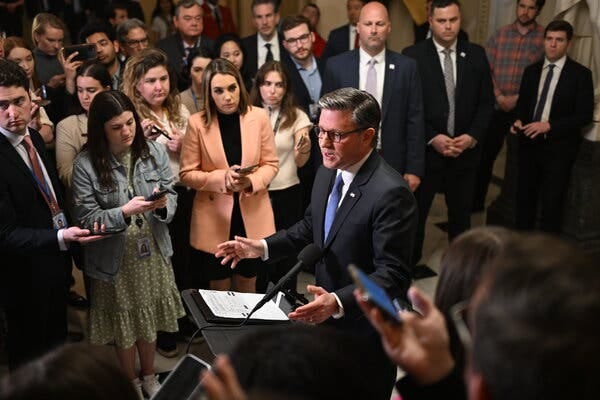
The House just voted to pass a bill to fund the Department of Homeland Security through September, the third time in two months that the chamber has approved funding for the department. Four Democrats joined Republicans to pass the bill, in a 218 to 206 vote.
Still, a funding deal remains stalled as the Senate remained at an impasse. Senators from both parties have said that talks are continuing and have sounded optimistic, and a bipartisan group has been having periodic conversations on the floor this afternoon.
Credit...Kenny Holston/The New York Times

March 26, 2026, 2:54 p.m. ET5 hours ago
Reporting from Washington
On President Trump’s mind at a cabinet meeting Thursday: Iran, inflation and Sharpies.
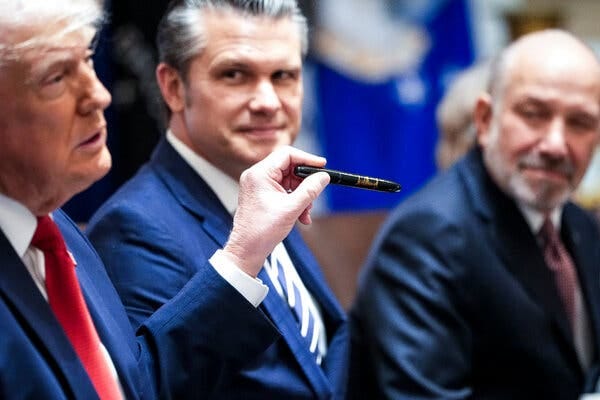
President Trump spent several minutes during Thursday’s cabinet meeting at the White House talking about the Sharpie pen he uses and comparing it to pens used by previous presidents.Credit...Doug Mills/The New York Times
President Trump assembled his cabinet on Thursday to talk about the war in Iran. But he also seized the moment to regale top officials with an extended digression about his preferred writing tool, the Sharpie.
In between complaining about the Fed chair Jerome H. Powell’s renovation of the central bank’s headquarters, he waxed on about the virtues of the Sharpie, which he said was more economical and a better writing instrument than the fancier ones preferred by his predecessors. It was an anecdote meant to signal his business acumen and man-of-the-people tastes.
“I came here. They have thousand-dollar pens, and, you know, you hand pens out, you’re signing and you hand them out. You’re handing them with all these people, sometimes you have 30 or 40 people, and they were $1,000 a piece,” he said.
The pens, Mr. Trump continued, “didn’t write well” and had “no ink.” He instead turned to the Sharpie when signing bills. “The bottom line is: They’re better pens,” he said. “It’s a business story. So for $5, it could be zero, but for $5, I get a much better pen than for $1,000.”
Mr. Trump is correct that Sharpies are cheaper, but he overstated the cost of past presidential writing instruments. (Whether Sharpies are better is in the eye of the penholder.)
A.T. Cross, which is based in Rhode Island, said it had manufactured the pens preferred by Presidents Bill Clinton, George W. Bush and Barack Obama, all of whom used the Townsend model. The pen, described by Cross as possessing a “bold profile, intricate detailing and superior writing performance,” now retails for about $200. (The classic black version costs about $265.)
President Joseph R. Biden Jr. preferred Cross’s Century II model, which the company says brings “modern flair to a time-honored design.” That model is slightly less expensive, ranging from $99 to $270 a pen.
Luxury pen enthusiasts, it should be noted, often describe Cross pens, as relatively affordable alternatives to other famous pens made by Montblanc and Nakaya, which can retail for over $1,000.
In contrast, Mr. Trump said that Sharpie agreed to create a special version for the White House, painting it black and embossing it with his signature in gold. The cost of that pen, he said, was only $5. Sharpie, Cross and the White House did not immediately respond to requests for comment.
It is unclear whether that exact model is available for purchase. But the president and his family have sold other versions.
After Mr. Trump in 2019 displayed a large map of a hurricane’s path that included a line drawn in black marker, his campaign began selling a set of five fine-point markers for $15. Last year, a version of Mr. Trump’s Sharpie was on sale at Mar-a-Lago for $3, The New York Times reported. The Trump Organization currently sells a Trump-branded pen for $25. It is unclear if that version is a Sharpie.
Mr. Trump’s renewed promotion of the brand did not appear to be enough to overcome the market fears caused by his war with Iran. The stock of Newell Brands, which makes Sharpies, fell steadily after the meeting.
Show more

March 26, 2026, 2:51 p.m. ET5 hours ago
Breaking news reporter
A group of Yemeni nationals sued the Trump administration for ending their deportation protections, and filed a petition to postpone their terminations until the court rules.
The Center for Constitutional Rights, along with the Asian American Legal Defense and Education Fund, filed the emergency relief petition late Wednesday in the U.S. District Court for the Southern District of New York. The brief argued that Yemen’s removal from the Temporary Protected Status program was “arbitrary and capricious” and violated the Administrative Procedure Act, which requires the executive branch to follow certain steps when it wants to change policies.
The Trump administration has long targeted the decades-old humanitarian program, which allows people fleeing crisis in their home countries to live and work in the U.S. Kristi Noem, the homeland security secretary, announced Yemen’s removal in February even as conflict there escalated. Protections for Yemenis end on May 4, according to the brief.


March 26, 2026, 1:32 p.m. ET7 hours ago
Michael C. Bender and Alan Blinder
Michael C. Bender and Alan Blinder have been covering the Trump administration’s efforts to force changes at American universities.
The Trump administration begins investigations into three medical schools.

Enrollment in medical programs is generally a fraction of that of undergraduate programs. At Stanford University, pictured, the incoming class this academic year had 119 students.Credit...David Madison, via Getty Images
The Trump administration has opened investigations into admissions policies at three major medical schools, expanding the federal government’s pressure campaign beyond campus culture and taking aim at the heart of scientific authority in the United States.
The Justice Department on Wednesday informed Stanford University, the Ohio State University and the University of California, San Diego, about the investigations and demanded that the schools turn over extensive lists of data by April 24 or risk interruptions to essential federal funding, according to two administration officials familiar with the inquiries and documents reviewed by The New York Times.
The government is seeking information about medical school applicants from each of the past seven years, including test scores, home ZIP codes and any familial relationships to alumni or ties to university donors. The administration also demanded copies of any internal messages at the universities about diversity, equity and inclusion and any correspondence between school officials and pharmaceutical companies about admissions policies.
“At this time, our investigation will focus on possible race discrimination in medical school admissions,” Harmeet K. Dhillon, the Justice Department’s assistant attorney general for civil rights, wrote in each of the letters.
Ms. Dhillon on Wednesday afternoon posted a picture on social media of her signing one of the letters with her fountain pen, a Pelikan Souverän with an 18-karat gold, extra-fine nib. “Launching a series of civil rights investigations,” Ms. Dhillon wrote. “Another day in paradise!”
Two hours later, an editor at Lawfare posted a zoomed-in version of Ms. Dhillon’s picture that revealed the letter was to Ohio State’s College of Medicine.
It was not clear how the Justice Department chose the three medical schools. A department spokesman declined to comment.
Officials at all three universities confirmed they had been notified about the inquiries. A Stanford spokeswoman declined to comment. U.C. San Diego said it was reviewing the notice from the Justice Department and that it was “committed to fair processes in all of our programs and activities, including admissions, consistent with federal and state anti-discrimination laws.”
An Ohio State spokesman, Ben Johnson, said the university was “fully compliant with all state and federal regulations and legal rulings regarding admissions.”
The government’s attacks on higher education during the past year have in part been aimed at tilting the political balance of academia, which President Trump views as hostile to his brand of conservatism. Some medical schools had been swept up in that campaign, but largely at universities like Harvard, the University of Pennsylvania and the University of California, Los Angeles, where the full force of the government was on display through investigations into antisemitism, protections for transgender athletes and admissions policies.
By directing a triad of investigations specifically at medical schools in a single day, the administration is widening its targets and transforming a decades-long financial partnership into a tool of cultural leverage.
That partnership dates back to a postwar consensus in the country that scientific progress is a fundamental public good — one too vital to be left to the vagaries of the market or the limitations of private philanthropy. Since the 1950s, the federal government has consistently operated as the predominant source of research funding for universities, according to the National Science Foundation.
One of the largest government sources of research funding has been the National Institutes of Health, which disburses about $35 billion each year. The largest recipients of those N.I.H grants are medical schools, according to the Association of American Medical Colleges.
The new round of investigations also signals the latest chapter in a growing legal dispute the administration has sparked over college admissions.
Earlier this month, a group of 17 state attorneys general, all Democrats, sued the Education Department over the government’s growing appetite for admissions data. They argued, in part, that the depth of detail sought by the government posed a “significant risk” of identifying students and exposing sensitive information, including financial aid.
The privacy concerns may be more pronounced at medical schools, where enrollment is generally a fraction of that of undergraduate programs. The incoming class of aspiring doctors and physician assistants at Stanford this academic year was 119 students. Ohio State welcomed 211 medical students, while U.C. San Diego enrolled 140.

The University of California, San Diego, ranked 14th among medical schools in 2025, with $427 million in grants from the National Institutes of Health.Credit...Jeremy Graham, via Alamy
In the Justice Department’s letters on Wednesday, Ms. Dhillon indicated that civil rights laws override privacy concerns. She added that the information would be “maintained in accordance with applicable federal confidentiality requirements.”
Beyond legal battles, the new investigations exemplify an indisputable flex of federal power in an effort to tilt the racial balance in medical education.
The inquiries did not arise from a complaint or allegation, which typically prompt federal action. Instead, the Justice Department has invoked its broad powers from Congress to proactively investigate any federally funded institution for compliance with the law.
But the Trump administration’s interpretation of civil rights law, particularly regarding the Supreme Court’s 2023 ruling ending affirmative action, is widely debated.
The administration’s civil rights investigations into admissions processes have tended to focus on potential discrimination against white applicants. The Supreme Court ruling did halt race-conscious admissions, but many university officials maintain that the justices did not forbid a less direct consideration of an applicant’s race, through interviews or essays included in the application process.
But the administration has taken a harder stance, and has attempted to codify its stricter reading of the ruling through executive orders signed by Mr. Trump and guidance from Attorney General Pam Bondi.
According to the Association of American Medical Colleges, there were 99,400 students enrolled in medical school for the 2025-26 academic year. About 42 percent of those medical students were white, 28 percent were Asian and about 8 percent were Black.
Those percentages closely aligned with the breakdown of the Ohio State medical school enrollment. The two California-based medical schools had about half as many white students, but a higher rate of Asian students. Black students accounted for 13 percent of the medical school enrollment at Stanford, and 6 percent at U.C. San Diego.
All three medical schools rank among the top recipients of N.I.H. funding.
In 2025, Stanford was awarded $575 million in N.I.H. grants, according to data compiled by the Blue Ridge Institute for Medical Research. Only U.C. San Francisco, Washington University in St. Louis, the University of Pennsylvania and Yale University were awarded more.
U.C. San Diego ranked 14th among medical schools, with $427 million in grants from the National Institutes of Health, while Ohio State received $210 million, 35th among medical schools.
The U.C. San Diego medical school is one of six within the University of California system, and largely enrolls California residents. But it is also a part of the public university system that has faced the most intense pressure from the Trump administration.
In California, federal officials have mostly focused on the campuses in Berkeley, which Ms. Dhillon visited last year, and Los Angeles. The Justice Department last month filed a lawsuit accusing the Los Angeles campus of being indifferent to antisemitism, and recently joined a separate lawsuit challenging admissions practices at its medical school. The San Diego campus, though, was the subject of an Education Department investigation into what the department described as “Title VI violations relating to antisemitic harassment and discrimination.”
Stanford has not come under as much pressure from Washington as many other elite universities, but it was targeted by the Justice Department last March in an inquiry related to its admissions policies. And the Education Department said last year that it was looking into accusations of antisemitism at Stanford.
Susan C. Beachy contributed research.
Show more
March 26, 2026, 1:20 p.m. ET7 hours ago
Congressional reporter
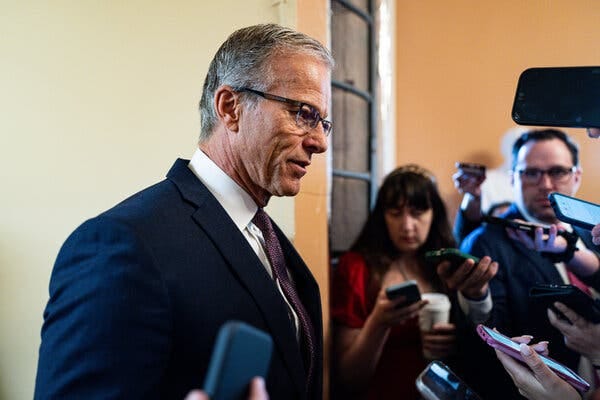
Senator John Thune, Republican of South Dakota and the majority leader, said that Republicans sent a new proposal to Democrats to fund the Department of Homeland Security.
The two sides are expected to continue negotiating today, as lawmakers try to find a way to end the ongoing shutdown, though Thune characterized the latest proposal as “what I think is our last and final” offer.
Credit...Tierney L. Cross/The New York Times
March 26, 2026, 12:48 p.m. ET7 hours ago
Reporting from the Capitol
Lawmakers press to ban prediction bets by policymakers.

People standing near a police station in Tehran that was damaged in U.S.-Israeli attacks. Over a hundred people made more than $10,000 by betting that the United States would strike Iran on Feb. 28.Credit...Arash Khamooshi for The New York Times
The day before President Trump began attacking Iran, more than 150 bettors correctly predicted that the United States would do so on Feb. 28. At least 109 of those accounts on Polymarket, one of the largest prediction markets, raked in over $10,000, and 16 accounts profited more than that.
The proliferation of such bets has raised concerns among members of Congress in both parties, who are pressing to enact legislation that would crack down on policymakers placing wagers on prediction markets.
In recent days, proponents of such measures have pointed to the betting on Iran and similar wagers on the U.S. invasion of Venezuela as potentially creating the impression that federal officials might be profiting off the secret information they are privy to on the job. They have also warned that if federal officials’ bets are not limited, betting patterns on military action could pose a national security threat.
“It’s an operational risk,” said Senator Elissa Slotkin of Michigan, the lead Democratic sponsor of the legislation on the matter, which was introduced on Thursday. “If you’re just hanging out on one of these sites, and suddenly you see a bunch of people placing large bets on military action, that is a tell that we’re about to take military action.”
Her legislation would bar any public official, from the president to low-level congressional aides, from placing prediction-market bets using nonpublic information they learn in the course of their jobs, with fines up to $500 or double the profit made on the bet for violations. Officials also would be required to report any bets valued at more than $250, including when they placed them, on what platform and any profit earned.
The popularity of betting on whether almost any event will occur, on sites like Polymarket and Kalshi, its main competitor, has soared in recent years. Bets on geopolitical developments have also included predictions on whether the United States would invade Greenland or Cuba. A Polymarket user bet $34,000 and earned over $400,000 for predicting that Nicolás Maduro would fall from power, hours before American troops captured the Venezuelan president.
Prediction markets can “create incentives for elected officials or other well-placed public individuals to change their behavior,” said Senator Todd Young of Indiana, the lead Republican sponsoring the measure, which he said would “cut down on any such incentives or temptations that those who hold positions of public trust might harbor.”
With the Iran war now in its fourth week, both senators said there was an urgent need to regulate prediction markets to protect sensitive information on the combat operations. Senator Adam B. Schiff, Democrat of California, and Senator John Curtis, Republican of Utah, are also backing the proposal.
Bets on the Iran war have been “very disturbing,” Mr. Curtis said, and are something Congress “should take very seriously.”
“It should be some pretty low-hanging fruit” to limit such activity among policymakers, he added.
Insider trading is already illegal. But proponents of the legislation argue that new penalties and reporting requirements are needed for government workers.
Both Kalshi and Polymarket announced Tuesday they would take steps to guard against insider trading on their platforms, but Mr. Schiff said the companies “can’t be left alone to self-police.”
A proposal introduced in the House on Wednesday would go further than the Senate measure, barring members of Congress, their family members and federal employees, including the president and vice president, from betting on prediction markets about “the occurrence of a specific political event.”
Representative Nikki Budzinski, Democrat of Illinois, said in a statement that “traders making massive profits on events ranging from war with Iran to how long a government shutdown will last” have raised “necessary questions” about federal officials profiting off insider information. She introduced the measure with Representative Adrian Smith, Republican of Nebraska.
Representative Seth Moulton, Democrat of Massachusetts, took matters into his own hands on Wednesday and barred his congressional staff from placing any bets on prediction markets.
Mr. Trump in his State of the Union address called on Congress to pass legislation that would place some stock-trading limits on lawmakers and their family members, though that effort appears stalled on Capitol Hill.
But it is not clear whether he would back bipartisan efforts to curb prediction bets. The president’s eldest son, Donald Trump Jr., is a paid adviser to Kalshi, and an unpaid adviser to and investor in Polymarket.
Ephrat Livni and Amy Fan contributed reporting.
Show more

March 26, 2026, 12:07 p.m. ET8 hours ago
U.S. foreign policy reporter
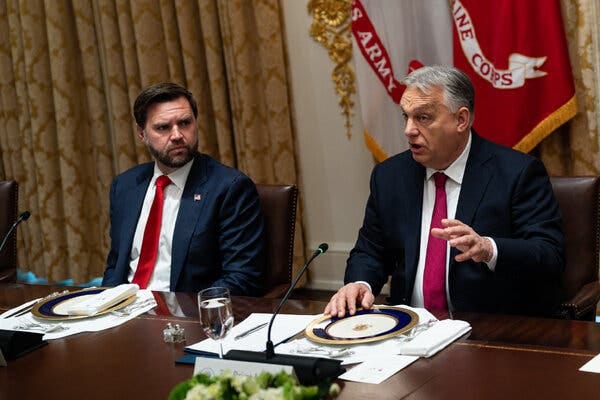
Vice President JD Vance plans to travel to Budapest in early April to meet with Viktor Orban, Hungary’s prime minister, just days before a critical election in the country that could force Orban to leave office, a U.S. official said.
President Trump has publicly supported Orban, a conservative leader who promotes authoritarian governance and policies. The White House has not announced Vance’s trip, and the vice president’s office did not have comment. Reuters reported earlier on Vance’s plans to go to Budapest.
In February, Secretary of State Marco Rubio visited Orban and said the Trump administration could give financial benefits to Hungary if Orban were to stay in power.
Credit...Tierney L. Cross/The New York Times

March 26, 2026, 12:03 p.m. ET8 hours ago
Mortgage rates jump again, as the Iran war’s effects ripple through the U.S. housing market.
U.S. average 30-year fixed-rate mortgage
Source: Freddie Mac.
The war in the Middle East continued to weigh on the U.S. housing market, as mortgage rates climbed for the fourth week in a row, squeezing Americans already struggling with high housing costs.
The average 30-year, fixed-rate mortgage rate climbed to 6.38 percent, according to the mortgage-financing giant Freddie Mac, up from 6.22 percent the week before and the highest level since the first week of September.
That rate is still significantly below its peak of 7.79 percent in October 2023. Until the war started, rates had been gradually declining, falling below 6 percent in the last week of February. The drop in rates had offered hope that more prospective buyers would enter the market, but rates have since marched steadily higher.
Mortgage rates are influenced by the yield on the 10-year Treasury note, which has risen as the war deepens uncertainty for investors. Bond yields have jumped in the past few weeks, hitting 4.38 percent on Thursday, up from just under 4 percent before the war began. Disruptions to energy supplies from the Middle East have led to surging oil and gas prices, intensifying fears of higher inflation.
The Organization for Economic Cooperation and Development warned on Thursday that the war would push up inflation in the United States to 4.2 percent this year, more than a percentage point higher than its previous forecast. A resurgence in inflation would make it more unlikely that Federal Reserve would cut interest rates this year, an expectation that feeds into higher bond yields — and mortgage rates.
President Trump has said that Iran is willing to negotiate a possible cease-fire, a proposal that the Iranian government has publicly dismissed.
The war is expected to slow the construction of new homes this year, according to a report from Oxford Economics, a global advisory firm. “Unless the war is brought to a quick end, higher mortgage rates and softer labor market conditions will weigh on residential spending this year,” Nancy Vanden Houten, the firm’s lead U.S. economist, wrote in the report.
Show more

March 26, 2026, 11:31 a.m. ETMarch 26, 2026
Finance reporter
Jared Kushner, President Trump’s son-in-law, said he was suspending attempts to raise money for his personal private equity firm as he concurrently serves as a top U.S. government Mideast negotiator.
The New York Times reported earlier this month that Kushner’s firm, Affinity Partners, had met recently with Saudi Arabian officials, among others, in an attempt to drum up more than $5 billion. That effort attracted predictably withering criticism from Democrats on Capitol Hill.
Kushner, speaking at a Miami investing conference organized by the Saudis, said that he would pause the efforts for an unspecified period.
March 26, 2026, 11:09 a.m. ETMarch 26, 2026
Economic policy reporter
The Trump administration lifted sanctions on the Belarussian finance ministry and several companies after the release of 250 political prisoners. The sanctions relief comes after the U.S. eased oil sanctions on Russia and Iran.

March 26, 2026, 8:47 a.m. ETMarch 26, 2026
The war will push U.S. inflation above 4 percent this year, according to a new forecast.
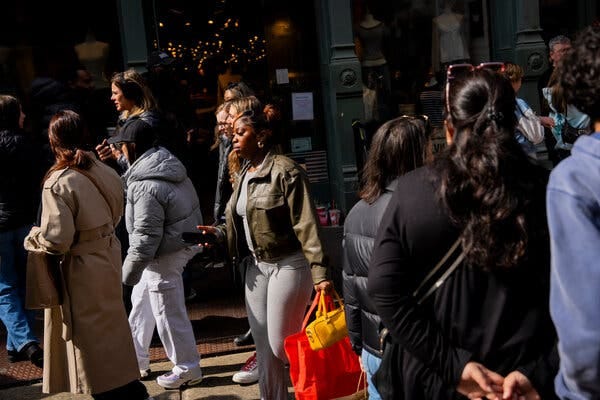
U.S. inflation is expected to average 4.2 percent this year, more than 1 percentage point higher than the O.E.C.D.’s previous forecast.Credit...Vincent Alban/The New York Times
The war in Iran will lead to a surge in inflation this year, as the closure of the Strait of Hormuz pushes up prices for oil, gas and other commodities, the Organization for Economic Cooperation and Development said on Thursday.
The inflation rate in the United States will average 4.2 percent this year, more than one percentage point higher than the group’s previous forecast, made late last year, the Paris-based organization said. Across the Group of 20 nations, inflation is forecast to average 4 percent this year, 1.2 percentage points higher than previously expected.
The global economy is projected to grow by 2.9 percent this year, an unchanged forecast, supported by spending on artificial intelligence.
“The resilience of the global economy is now being tested,” the O.E.C.D. said in a report. There is a “significant” risk to its projections if there are persistent disruptions to exports from the Middle East.
For the past month, shipping through the Strait of Hormuz, a critical waterway off the southern coast of Iran, has plummeted because of attacks on ships. That, along with attacks on energy infrastructure across the Persian Gulf region, has led to a sharp reduction in the supply of energy, as well as other goods such as fertilizers. That will push up the costs of food and other goods.
“Higher energy and fertilizer prices and the unpredictable nature of the evolving conflict in the Middle East will add to inflation and weigh on demand,” the O.E.C.D. said.
In the United States, growth momentum from the beginning of this year is expected to be offset by a slowdown in consumer spending. At the same time, the impact of higher energy prices will outweigh the effect from lower tariff rates on imports. The jump in inflation narrows the chances that the Federal Reserve will be able to cut interest rates this year.
Among the G20 countries, Britain is forecast to suffer the biggest hit to growth, in addition to a large increase in inflation.
The O.E.C.D. said that central bankers needed to remain vigilant for signs that the energy shock could lead to a longer-term increase in inflation, and that lawmakers should respond to higher prices with “temporary and well-targeted measures” because of pressure on government budgets.
Show more

March 26, 2026, 8:10 a.m. ETMarch 26, 2026
Reporting from Washington
The U.S. military kills 4 people in a boat strike in Caribbean.
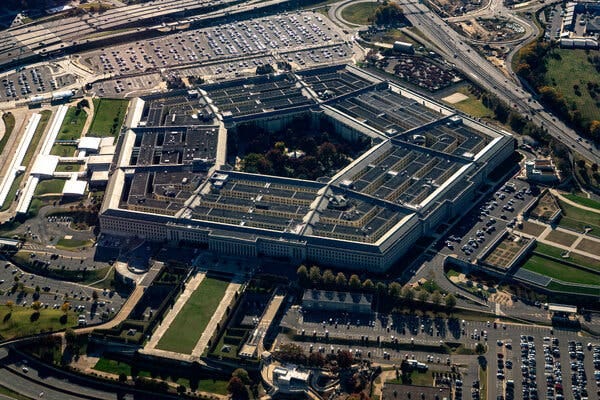
The Pentagon said it blew up a boat in the Caribbean on Wednesday, the 47th such attack since the campaign started in early September.Credit...Kenny Holston/The New York Times
The Pentagon said it blew up a boat in the Caribbean Sea on Wednesday, killing four people. The strike raised the death toll in the Trump administration’s campaign against people it accuses of smuggling drugs at sea to at least 163 people.
The U.S. military’s Southern Command announced the strike on social media with a 15-second video clip that showed a stationary boat floating in the water and then suddenly exploding.
Legal specialists on the use of lethal force have said the strikes are illegal, extrajudicial killings because the military cannot deliberately target civilians who do not pose an imminent threat of violence, even if they are suspected of engaging in criminal acts. The Trump administration has not provided evidence of drug smuggling.
Southern Command, which oversees military operations in Latin America and the Caribbean from its headquarters near Miami, cited unspecified intelligence in its announcement. It said the boat had been traveling on “known narco-trafficking routes” and was “engaged in narco-trafficking operations.”
The attack, the 47th since the U.S. campaign against boats in the Caribbean and the Eastern Pacific started in early September, continued a recent increase in the pace of strikes.
Gen. Francis L. Donovan, the head of Southern Command, acknowledged last week that the U.S. strikes “aren’t the answer” to the nation’s drug problem.
In testimony to the Senate Armed Services Committee, General Donovan said the strikes had forced narco-terrorist groups in the region to change their operational patterns but were not a long-term solution.
Show more

March 25, 2026, 10:49 p.m. ETMarch 25, 2026
Reporting from Washington
Trump calls for a law cracking down on crime and ‘rogue judges.’
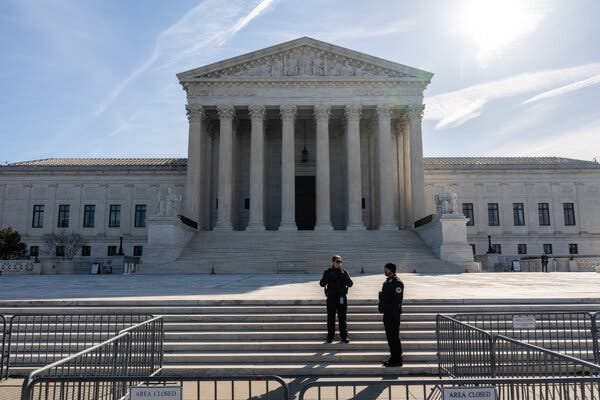
President Trump and top aides have been railing against judges who have ruled against him, including justices on the Supreme Court.Credit...Eric Lee for The New York Times
President Trump escalated his attacks on judges on Wednesday, calling on Republican lawmakers to pass a crime bill that “cracks down on rogue judges.”
Mr. Trump and top aides have been railing against judges who have ruled against him, including justices on the Supreme Court, but he had not yet called for a legal crackdown on sitting judges.
“The time has also come for Republicans to pass a tough new crime bill that imposes harsh penalties for dangerous repeat offenders, cracks down on rogue judges. We got rogue judges that are criminals. They are criminals, what they do to our country. The decisions that they hand down and hurt our country,” Mr. Trump said at a National Republican Congressional Committee event in Washington.
When asked what measures Mr. Trump would want taken against judges he labels as “rogue” or “criminals,” the White House referred to the president’s statements.
Mr. Trump has previously said that he would not sign any legislation until a strict voter identification bill was passed, saying that it would “guarantee the midterms” for his party. He appeared to suggest that a crime bill could be handled after the midterms. Mr. Trump said on Wednesday that “if we get a few more votes,” then “we could do things that would be a miracle. We got to get out and win.”
The midterm campaign pledge was the latest escalation in Mr. Trump’s barrage of attacks against the federal judiciary, which have grown increasingly pointed after the Supreme Court struck down his wide-reaching tariffs as unlawful. The acrimony has been echoed by aides like Stephen Miller, Vice President JD Vance and even in the Justice Department, where prosecutors are attacking federal judges in their court filings and legal arguments.
Last week, Chief Justice John G. Roberts Jr. denounced personal attacks aimed at judges and justices, calling them “dangerous.”
On Wednesday, Mr. Trump singled out the Supreme Court’s tariff decision as he spoke of court rulings that have blocked his policies.
“The decisions that these people make,” Mr. Trump said. “I got a decision on tariffs that’s going to cost our country — not me, I do it a different way — going to cost our country hundreds of billions, potentially, of refunds. Giving them back to people that have been ripping off our country.”
The vast majority of the economic burden of Mr. Trump’s tariffs has fallen on U.S. companies and consumers. An estimated $166 billion in illegal duties were collected by the Trump administration, and U.S. businesses are clamoring for refunds.
Mr. Trump then complained that “the Supreme Court didn’t want to put one little sentence that all money taken in up ’til this day doesn’t have to be paid back.” He added: “Going to cost us hundreds of billions of dollars. So sad to see.”
Erica L. Green contributed reporting.
Show more

March 25, 2026, 7:29 p.m. ETMarch 25, 2026
The Justice Dept. settles Flynn’s wrongful prosecution suit for $1.25 million.
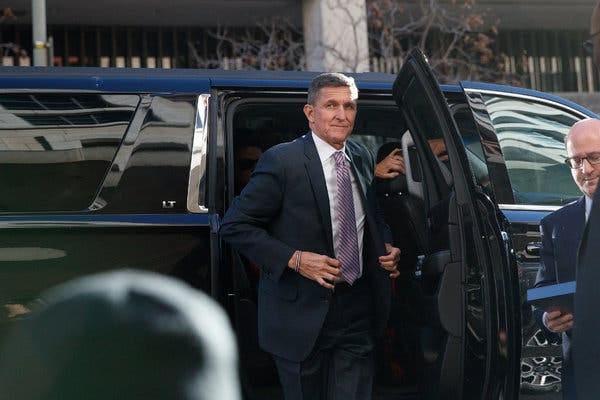
Michael T. Flynn, seen in 2018, briefly served as President Trump’s national security adviser in his first term.Credit...Tom Brenner for The New York Times
The Justice Department has agreed to pay Michael T. Flynn, President Trump’s former national security adviser, $1.25 million to settle claims that he was wrongfully prosecuted for making false statements to federal agents investigating ties between Russia and Mr. Trump’s 2016 presidential campaign, a person familiar with the matter said on Wednesday.
The settlement agreement, which put to rest a lawsuit Mr. Flynn filed three years ago, was an extraordinary example of how the Trump administration has offered legal relief to those aligned with the president. It appeared to be part of a broader effort to erase the effect of some of the prominent criminal cases brought against Mr. Trump and his allies.
Mr. Flynn’s suit, filed in Federal District Court in Tampa, accused federal prosecutors of maliciously charging him with lying to investigators who were working on the Russia inquiry, even though he had twice pleaded guilty to misleading the F.B.I. about conversations he had had with a Russian diplomat as Mr. Trump was poised to enter the White House for the first time.
In 2020, after an unusual pressure campaign by Mr. Trump and several of his allies, the Justice Department dropped its case against Mr. Flynn, chiseling away at the results of the Russia investigation.
Both the Justice Department and Mr. Flynn himself hailed the agreement in separate statements, hinting at the cooperative nature of the settlement.
A department spokeswoman called it “an important step in redressing” a “historic injustice,” and accused those who had worked on the Russia investigation of abusing their power.
Mr. Flynn, in a statement issued by his lawyer, Jesse Binnall, said he was pleased by the agreement, which ended “a coordinated effort to pursue an innocent man as part of a broader campaign to undermine President Trump and his administration.”
“It marks a meaningful step toward righting a profound wrong,” the statement said.
The Russia investigation, which unfolded during much of Mr. Trump’s first term in office, ultimately determined that his 2016 campaign had not conspired with Russia to help him win the White House, but explicitly did not exonerate him on separate accusations of obstructing justice. The inquiry was first led by James B. Comey, the F.B.I. director, and then after he was fired by Mr. Trump, by the special counsel Robert S. Mueller III, who died last Friday.
Mr. Trump has long complained that the F.B.I. mistreated Mr. Flynn, even though Mr. Trump fired him weeks into his first presidency for lying to Vice President Mike Pence about the conversations with the Russian diplomat. In late 2020, after he lost that year’s election to Joseph R. Biden Jr., Mr. Trump pardoned Mr. Flynn, bringing an end to the drawn-out legal saga of his prosecution.
But the end of his criminal case was in essence the beginning of Mr. Flynn’s efforts to sue the Justice Department in a claim that originally sought $50 million.
He accused federal law enforcement of opening “a baseless investigation” into him and ultimately filing “unjustified criminal charges.” The Biden administration sought to dismiss the suit, but the litigation took a different turn after Mr. Trump re-entered the White House.
Time and again, the Justice Department under Mr. Trump has sought to use the legal system to punish the president’s enemies and reward his allies and supporters — including those who have filed wrongful prosecution suits.
Last year, the department paid nearly $5 million to settle a wrongful-death lawsuit brought by the relatives of Ashli Babbitt, an Air Force veteran who was killed by the police during the storming of the Capitol on Jan. 6, 2021.
Mr. Trump himself has filed claims demanding that the Justice Department pay him about $230 million in compensation for the two federal prosecutions in which he faced separate charges of trying overturn the 2020 election and illegally holding on to reams of classified documents after he left office in 2021.
Show more


March 25, 2026, 6:04 p.m. ETMarch 25, 2026
Apoorva Mandavilli and Sheryl Gay Stolberg
Trump to delay nominating new C.D.C. director.
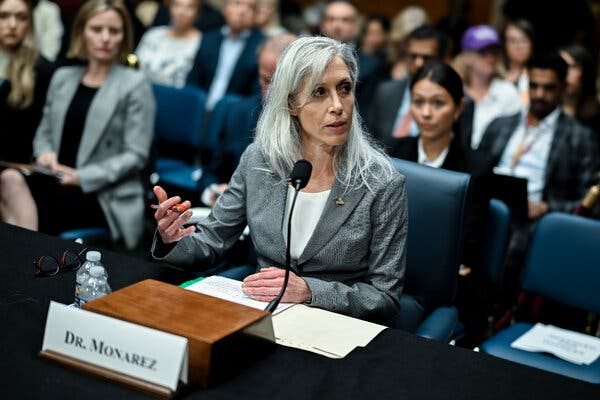
Under federal law, the White House had until midnight on Wednesday to nominate a replacement for former Centers for Disease Control and Prevention director Susan Monarez.Credit...Kenny Holston/The New York Times
The White House plans to delay naming a candidate to head the Centers for Disease Control and Prevention, an agency that has been roiled by a string of high-level departures and has had three different leaders since President Trump returned to the White House, according to people familiar with the situation.
Federal law imposes a 210-day limit on those filling Senate-confirmed positions in an acting capacity. The agency became officially leaderless after Mr. Trump did not nominate a permanent director by midnight on Wednesday.